First ATU-10 Activation: Trail Creek State Fishing Lake (US-12001)
The QRP Labs QMX+ has been in the field before, but today was the first activation with the ATU-10 tuner in the kit. Previous outings used a 40-meter EFHW — resonant on 40, 20, 15, and 10, and honestly probably a better antenna on those bands. But a 40m EFHW doesn't cover 80m, 30m, 17m, or 12m. The random wire with the ATU-10 tunes every band from 160 to 10, which means you go where the conditions are instead of where your antenna lets you.
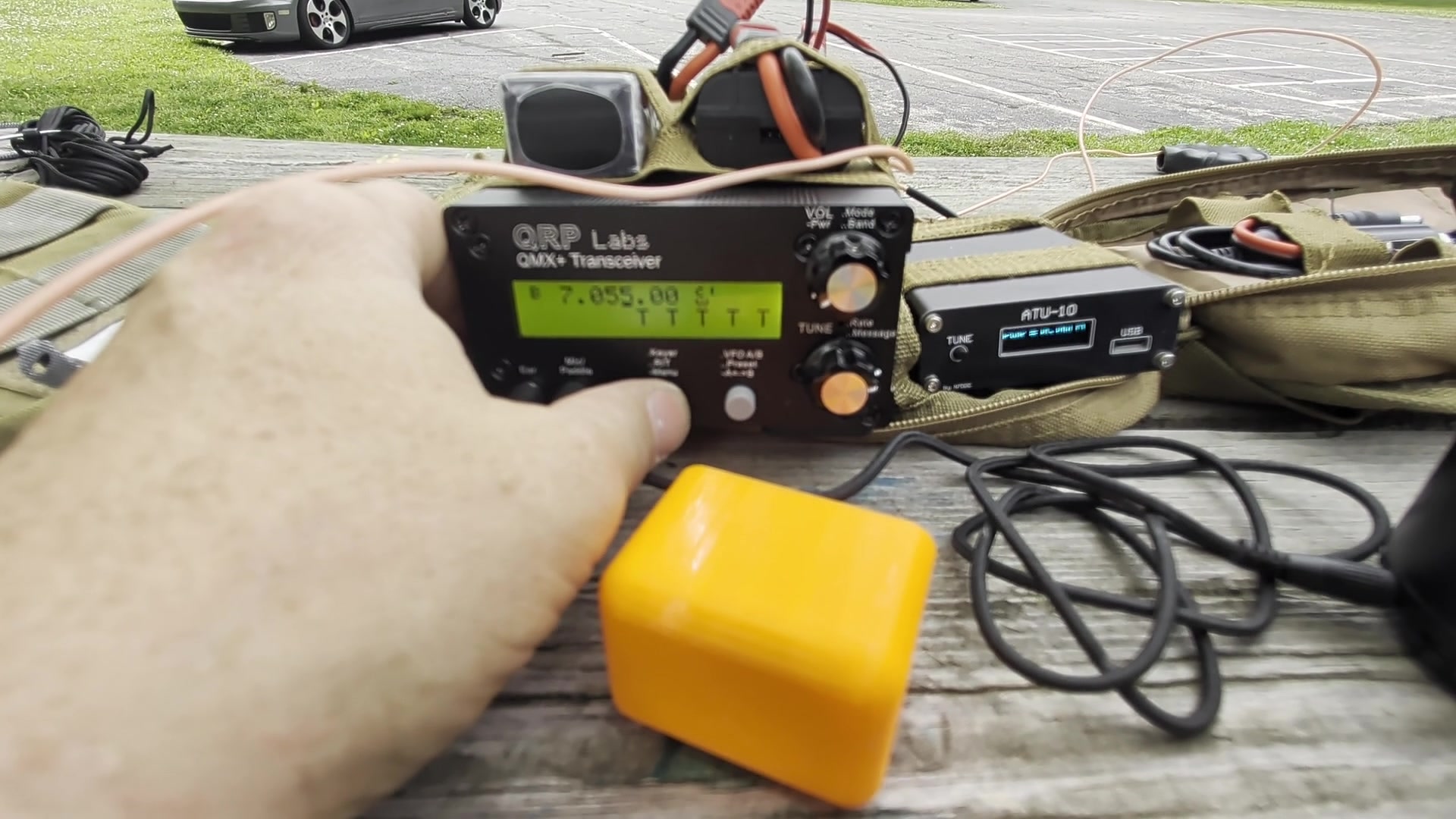
The Park
US-12001 is listed in the POTA database as Trail Creek State Fishing Lake. The sign at the entrance says Creek Ridge County Park. Both are accurate — it's a county-administered facility on state-owned land, which is why it qualifies as a POTA entity under Indiana's state fishing lake program. Confusing on the ground but a legitimate activation.
The QMX+
I picked up the QMX+ kit at Hamvention and built it at home over the following week or so — about six hours total, spread across a few evenings. It's a 5-watt CW and SSB transceiver covering 160 through 6 meters. The kit is well designed and the instructions are thorough. Toroid winding is never my favorite part of any build but there's nothing unusual here. The alignment at the end — a few small tweaks to three of the toroids to get the readings in spec — was actually the easiest part. It came together cleanly and has been working well in the field since.
Getting the ATU-10 to Actually Tune
The ATU-10 arrived this week. Before heading to the park I bench-tested it at home with the QMX+ and ran into a problem: I'd press tune, hear one relay click, and then nothing. The tuner was detecting RF and immediately giving up.
I plugged the ATU-10 into the laptop and used Claude Code to dig into it. The ATU-10 exposes its configuration as EEPROM cells in the firmware hex — Cell 4 sets the minimum power threshold required before the tuner will start a tuning cycle. The default is 10, which decodes to 1.0W. The QMX+ SWR tune carrier comes in below that. One click and done.
Claude Code edited the hex directly, changed Cell 4 from 10 to 01 (0.1W), recalculated the checksum, and copied the new firmware to the ATU-10's USB mass storage volume. After reflashing, the tuner ran its full relay cycle and locked on a match. That was the fix.
If you're running any QRP radio with an ATU-10 and seeing the single-click symptom, that's almost certainly the cause.
The Tuning Process on the QMX+
The QMX+ has a built-in SWR tune function that makes working with an external tuner easy, but it's not obvious if you haven't done it before. The path is Menu → Hardware Tests → SWR Tune → Go. The radio puts out a continuous carrier at reduced power — enough for the ATU-10 to see RF and run its algorithm. You hear the relays clicking through combinations, it latches, and you're done. Ten to fifteen seconds per band.
With the 0.1W threshold in place, the ATU-10 tuned every band cleanly including 20 meters, which had been the problem band on the bench.
Power Monitoring
Two small Amazon finds that are now permanent parts of the kit:
A Protooma 12V buck-boost converter sits between the battery and the radio. It accepts anything from 8V to 40V in and puts out a regulated 12V at up to 3A. Useful when running off a LiPo whose voltage sags under load — the QMX+ wants stable 12V and this keeps it there without thinking about it. Waterproof, compact, inexpensive.
In series with that is a 200A inline watt meter — the kind of instrument RC hobbyists use to monitor battery discharge. It shows voltage, current, and watts in real time, and accumulates amp-hours and watt-hours across the session. At the end of 11 QSOs I could read exactly how much of the battery I'd used. For field operating where you're watching your power budget, having that number rather than guessing is worth the few dollars.
The Antenna
A short 9:1 random wire built by Rob W9PRK — a local ham whose field antennas I've been using for a while now. Threw it up into a tree at the park and the ATU-10 handled the rest.
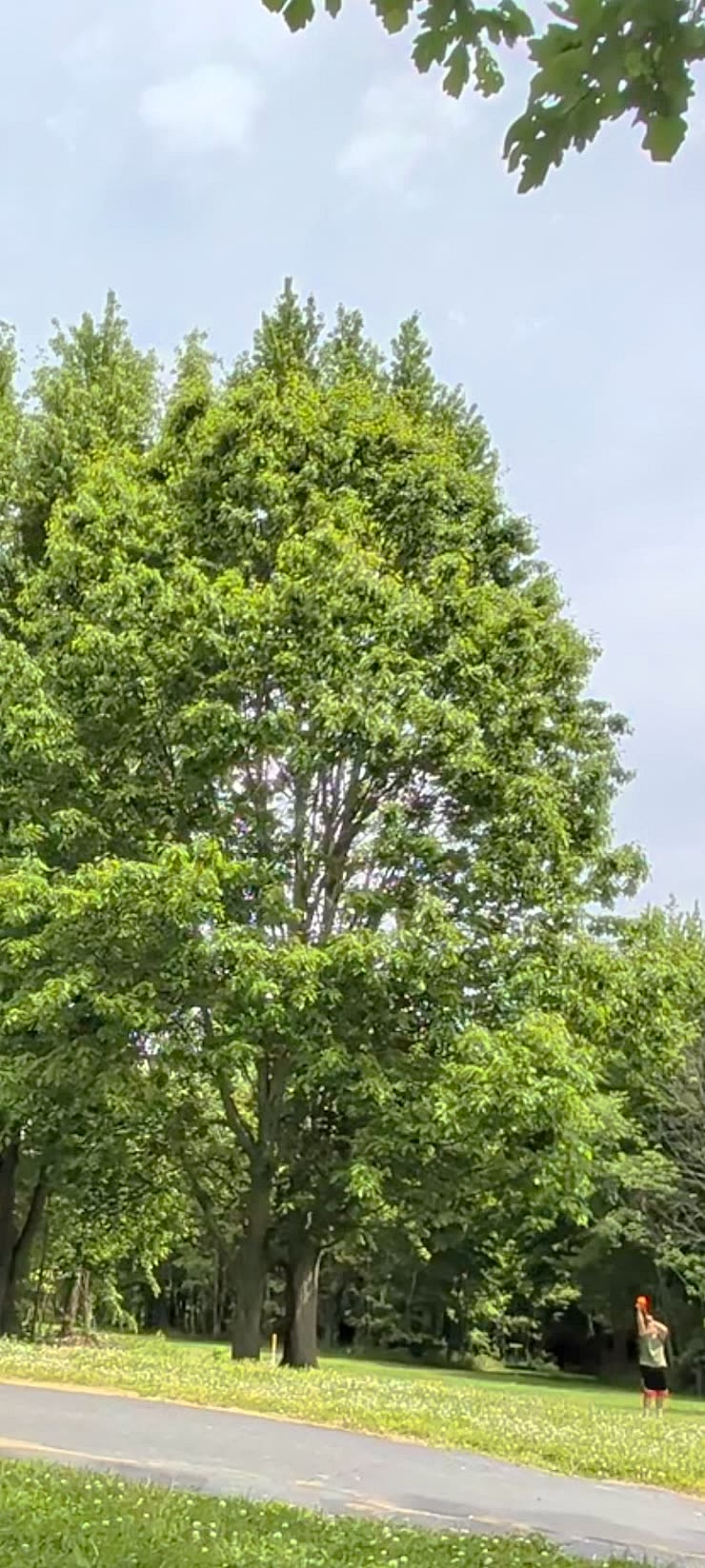
Getting the Wire Up: The Freeshot Launcher
Getting a random wire into a tree used to mean throwing a wrench with 550 cord and hoping for the best. I've been using a Freeshot antenna launcher (designed by KE2GYH, free STL on MakerWorld) — a 3D-printed slingshot-style launcher that uses a small weight and a pocket shot pouch to loft line cleanly over a branch on the first or second try. Total cost for parts is around $10–15 plus filament.
My dozen copies were printed by Andrew KE9DMQ, a local ham who runs a printer and knocked them out as a batch. I brought them to Hamvention with the idea of selling them as a quick-start kit for portable ops. Sold exactly one. The remaining eleven are stacked in my shack if anyone wants one. The design is free anyway — if you have a printer or know someone who does, just grab the file and make your own.
The Paddle: Zippy Paddle
The CW for this activation was sent on a Zippy Paddle — a fully 3D-printed iambic paddle designed by Zeus K8CES, also free on Thingiverse. It uses ball bearings for smooth paddle action, prints without supports, and is fully adjustable with magnetic return instead of springs. V1.2 (January 2026) tightened up the bearing pockets and added a locating dowel that keeps the case halves aligned under field use. It's also just the right size — small enough for a shirt pocket but comfortable in the hand.
For a piece of gear that costs maybe a dollar in filament and a handful of M2 hardware, it punches well above its weight class. KE9DMQ printed this one too. If you're looking for a portable CW paddle and have access to a printer, this is the one I'd recommend starting with.
The Log
11 QSOs across 40m, 30m, and 20m. Mostly CW with one phone contact at the end of the session.
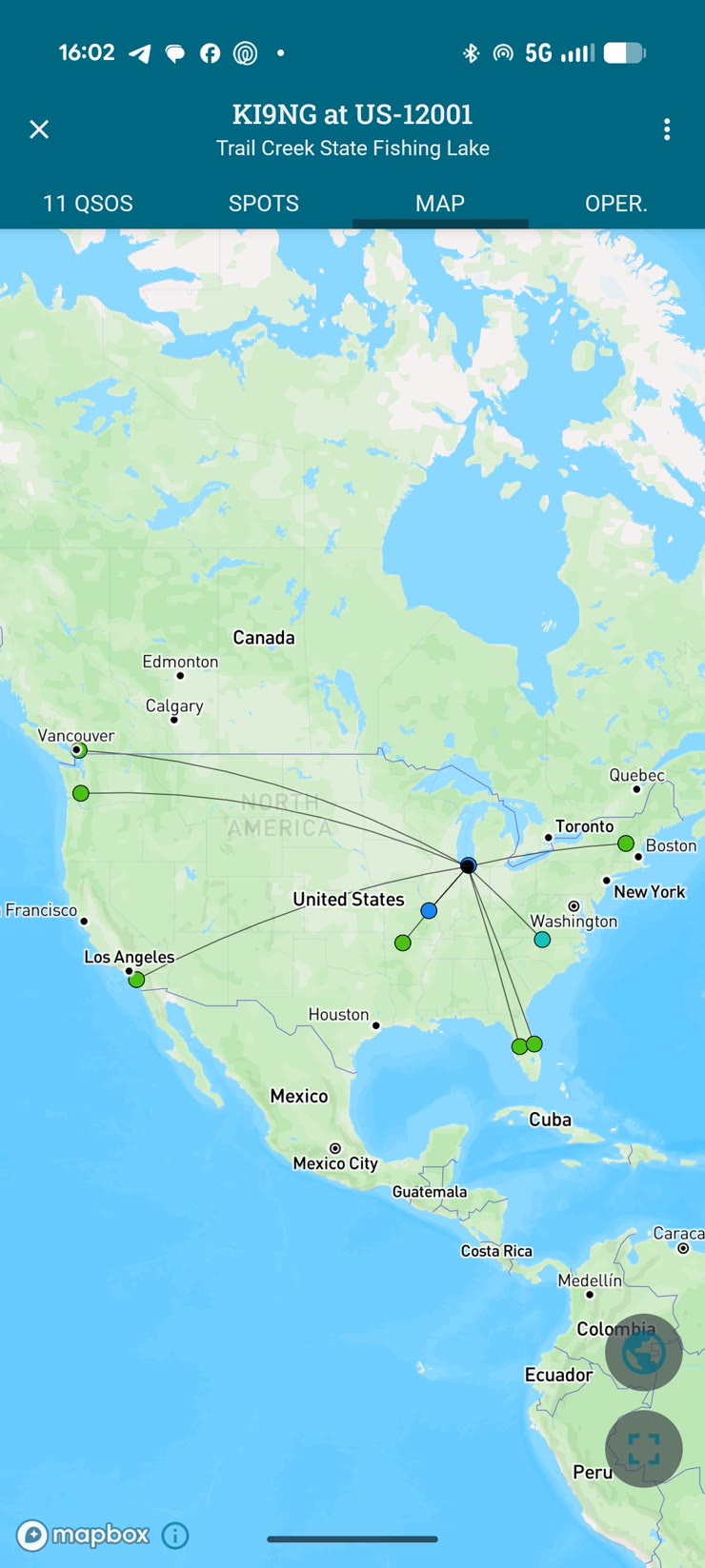
Started on 40m with KA8UGB in Michigan, then moved to 20m where the band was open. AI7RK in Washington and VE7SRF in British Columbia were the standout contacts — cross-country and cross-border, both solid 599 CW exchanges on 5 watts into a random wire.
Two park-to-park contacts on the day: VE7SRF was operating from CA-3240 in BC, and K3RTA in Delaware caught me on 30m from US-2743. Always a nice bonus.
The phone contact was N6FCM in California — 59 both ways on 14.307. First time out with a Palm Radio mini microphone. It clips to the strap, weighs nothing, and sounds clean. N6FCM gave it a solid report on the first try.
Last contact of the day was W9PRK on 40m — the same Rob who built the antenna. A good way to close it out.
Gear
| Radio | QRP Labs QMX+ (kit-built, 5W, 160–6m CW/SSB) |
| Tuner | ATU-10 automatic antenna tuner |
| Antenna | 9:1 random wire by W9PRK |
| Power | Protooma 12V buck-boost converter |
| Monitoring | 200A inline watt meter (RC LCD type) |
| Mic | Palm Radio mini microphone |
| Paddle | Zippy Paddle (3D-printed iambic, by Zeus K8CES) |
| Launcher | Freeshot antenna launcher (3D-printed, by KE2GYH) |
| Logging | Ham2K Portable Logger on Android |
Bill KI9NG | EN61 | DMR 3200395